Rare Books
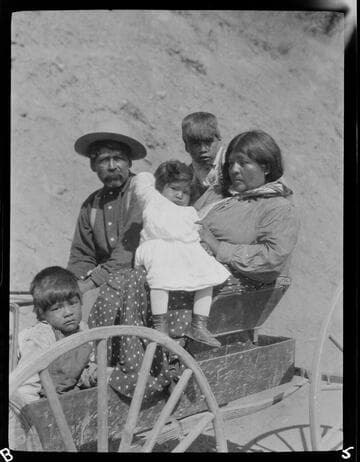
The chicken-wagon family
Image not available
You might also be interested in
Image not available
"Fort Niobrara Nebraska" [West family on wagon]
Manuscripts
HM 81548: The first volume, written in ink, consists of miscellaneous reports prepared by Frank West. The volume begins with a report about a transportation march from Camp Supply, Indian Territory to Fort Clark, Texas in 1873. West meticulously details the journey of the cavalry including length of travel, rivers crossed, and personal remarks. "Our wagon was [?] in the quick sand at the crossing of the Red River men were disseminated and applied to ropes attached to the wagon and it was drawn out" (p. 2). The total distance of their march was 1,371 miles, which took 74 days. The next two reports are about the murder of Jacob Dilsey in 1873. Other reports include number of utility poles erected in Arizona and confidential statements and endorsements about various Army personnel. Also included are briefs from Fort Niobrara, Nebraska and Fort Myer, Virginia. The last portion of the volume appears to be excerpts from a history book concerning Europe, Asia, and the Middle East during the 19th century. The endpapers have miscellaneous notes and account information written on them.
mssHM 81548-81554
Image not available
Prairie Chicken
Visual Materials
The Citrus label collection contains more than 1,500 lithographed labels related to the California citrus industry in the United States from 1880 to 1960, with the bulk of the collection dating from 1890 to 1940. The vast majority of the collection consists of lithographed labels produced for Californian growers, packers, and distributors to identify brand names and packing locations on wooden shipping crates of oranges, lemons and grapefruits. Many of the labels were printed by Los Angeles and San Francisco lithographers. The collection includes a range of lithography techniques from crayon drawing and hand stippling to the use of Ben Day screen patterns and half-tone lithography. The collection also includes more than 100 examples with "bronzing," a printing technique where varnish is printed on the label, followed by a dusting of fine bronze powder. A significant number of labels are stamped on verso with a received date by the Fruit Growers Supply Company, and some include signatures of approval or notations about printing corrections. The collection provides a broad view of the development of citrus fruit advertising over time, and also touches upon topics of commerce, manufacturing, travel and tourism, and promotion of the western United States. In the earliest examples, themes include naturalistic designs of flowers, animals, women, historical subjects, and scenic landscapes. Brand names, simple designs, block letters, and geometric patterns dominate in later examples. Many of the labels depict orange groves, scenic views, or flowers, though the collection also includes a wide variety of imagery beyond these themes including Native Americans, transportation, children, and portraits of famous or fictional people.
ephCL P_79
Image not available
Prairie Chicken
Visual Materials
The Citrus label collection contains more than 1,500 lithographed labels related to the California citrus industry in the United States from 1880 to 1960, with the bulk of the collection dating from 1890 to 1940. The vast majority of the collection consists of lithographed labels produced for Californian growers, packers, and distributors to identify brand names and packing locations on wooden shipping crates of oranges, lemons and grapefruits. Many of the labels were printed by Los Angeles and San Francisco lithographers. The collection includes a range of lithography techniques from crayon drawing and hand stippling to the use of Ben Day screen patterns and half-tone lithography. The collection also includes more than 100 examples with "bronzing," a printing technique where varnish is printed on the label, followed by a dusting of fine bronze powder. A significant number of labels are stamped on verso with a received date by the Fruit Growers Supply Company, and some include signatures of approval or notations about printing corrections. The collection provides a broad view of the development of citrus fruit advertising over time, and also touches upon topics of commerce, manufacturing, travel and tourism, and promotion of the western United States. In the earliest examples, themes include naturalistic designs of flowers, animals, women, historical subjects, and scenic landscapes. Brand names, simple designs, block letters, and geometric patterns dominate in later examples. Many of the labels depict orange groves, scenic views, or flowers, though the collection also includes a wide variety of imagery beyond these themes including Native Americans, transportation, children, and portraits of famous or fictional people.
ephCL P_112
Image not available
With Chicken and Dog
Manuscripts
The Albert R. Hibbs Papers, 1884-2009 (80 boxes) document the personal life and career of Hibbs as a manager and scientist at the Jet Propulsion Laboratory (JPL), the relationships between JPL, the National Aeronautics and Space Administration (NASA), and the California Institute of Technology (Caltech), and the development of the solar system exploration programs. Hibbs' consulting work for television and radio programs, Biosphere 2, and Morgantown Area Rapid Transit System (MARTS) are also documented. Although the collection arrived at The Huntington in disarray, original order of the materials was maintained when possible and the arrangement reflects Hibbs' general organization by correspondent, subject, or format of materials. The collection is divided into ten series: Audio Visual Materials, Consulting Files, Jet Propulsion Laboratory (JPL), Notebooks, Personal Files, Photographs and Negatives, Presentations and Speeches, Publications and Writings, Teaching Files, and Oversize. The bulk of collection materials date from 1931 to 1999 and consists of audio and video tapes, clippings, correspondence, memoranda, notes, photographs, publications, speeches, and writings. As the collection is arranged by both subject and format of the materials, researchers should be aware that materials are often dispersed through the series. For example, materials related to specific subjects are frequently represented in the JPL and Notebooks Series; similarly, Hibbs' friendship and collaboration with Roy L. Walford is documented in the Correspondence and Aging Research and Writings subseries of the Personal Series, in the Space Bioshpheres Ventures subseries of the Consulting series, as well as in the Audio Visual Materials Series. Correspondence is also dispersed throughout the series.
mssHibbs