Rare Books
Lives of the artists
Image not available
You might also be interested in
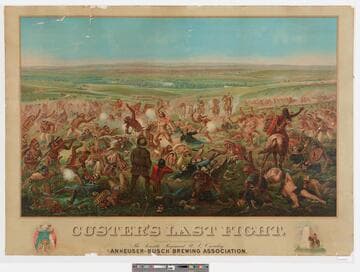
Custer's last fight
Visual Materials
Image of the Battle of Little Bighorn in Montana during the Great Sioux War of 1876 between Plains Indian tribes and the United States Army 7th Cavalry Regiment under General George Custer; bodies of dead and wounded litter the ground while intense fighting continues with swords, guns, spear, and other weapons; Indians are pictured killing wounded soldiers or scalping bodies; more Indians on horseback race across the plains to join the battle in the background; military medal, bugle, sabers, and flags grouped in lower left margin; man on horseback near a monument in lower right margin; text key in bottom margin indicates figures such as "half breed" and "Cheyenne warrior" as well as specific U.S. soldiers, including General Custer.
priJLC_MIL_001307
Image not available
Lauren Winfield Aldrich papers
Manuscripts
The group includes a handwritten draft and a typed transcript of Aldrich's manuscript entitled "Brief reminiscences of the soldiers life on the plains and in the mountains during the early days of 1867-8-9 to 70." This memoir discusses Aldrich's experiences serving as an army scout in Nebraska and Wyoming at forts along the route of the Union Pacific Railroad construction. Aldrich was assigned to Fort Laramie, Fort Russell, Fort Fetterman, and Fort Kearny. He describes his regiment's skirmishes with the Arapaho, Cheyenne, and Sioux Indians, as well as their dealings with the Pawnee scouts. Aldrich also talks about a treaty with Chief Red Cloud, his relationship with Major Frank J. North and Captain Luther H. North, and an expedition into the Yellowstone River Valley. Also included are several pieces of correspondence, certificates, and discharge papers related to Aldrich's military career and his duties for the National Indian War Veterans
mssHM 65812-65821
Image not available
Photographs 1-12
Visual Materials
This is a collection of mostly studio portraits of Native Americans from the Midwestern and Southwestern United States taken during the American Indian Wars. There are also views of their homes and camps on reservations. The photographs in this collection depict members of the Arapaho, Cheyenne, Comanche, Crow, Kiowa, Osage, and Wichita tribes during the American Indian Wars; Native American camp sites on Indian reservations; chieftains; a medicine man; native prisoners of war; native women and children; braves and their families; tipis; native families; and native scouts for the U.S. army. Notable portraits include Lone Wolf, Satank, Chief Stumbling Bear, and Chief Powder Face. William S. Soule is the photographer of the first 23 photographs, and Fred Miller is the photographer of the last two.
photCL 189
Image not available
Arapahoe camp near Camp Supply, Indian Territory. 1869. [(Belous): Indian encampment, 1868]
Visual Materials
This is a collection of mostly studio portraits of Native Americans from the Midwestern and Southwestern United States taken during the American Indian Wars. There are also views of their homes and camps on reservations. The photographs in this collection depict members of the Arapaho, Cheyenne, Comanche, Crow, Kiowa, Osage, and Wichita tribes during the American Indian Wars; Native American camp sites on Indian reservations; chieftains; a medicine man; native prisoners of war; native women and children; braves and their families; tipis; native families; and native scouts for the U.S. army. Notable portraits include Lone Wolf, Satank, Chief Stumbling Bear, and Chief Powder Face. William S. Soule is the photographer of the first 23 photographs, and Fred Miller is the photographer of the last two.
photCL 189
Image not available
Osage scouts employed by Gen. Alfred T. Sully (Lt. Col. 3rd Infantry), campaign of 1867-1868
Visual Materials
This is a collection of mostly studio portraits of Native Americans from the Midwestern and Southwestern United States taken during the American Indian Wars. There are also views of their homes and camps on reservations. The photographs in this collection depict members of the Arapaho, Cheyenne, Comanche, Crow, Kiowa, Osage, and Wichita tribes during the American Indian Wars; Native American camp sites on Indian reservations; chieftains; a medicine man; native prisoners of war; native women and children; braves and their families; tipis; native families; and native scouts for the U.S. army. Notable portraits include Lone Wolf, Satank, Chief Stumbling Bear, and Chief Powder Face. William S. Soule is the photographer of the first 23 photographs, and Fred Miller is the photographer of the last two.
photCL 189
Image not available
Quo-opah, or "Lone Wolf," Kiowa chief. *(Nye): Gui-pah-go]
Visual Materials
This is a collection of mostly studio portraits of Native Americans from the Midwestern and Southwestern United States taken during the American Indian Wars. There are also views of their homes and camps on reservations. The photographs in this collection depict members of the Arapaho, Cheyenne, Comanche, Crow, Kiowa, Osage, and Wichita tribes during the American Indian Wars; Native American camp sites on Indian reservations; chieftains; a medicine man; native prisoners of war; native women and children; braves and their families; tipis; native families; and native scouts for the U.S. army. Notable portraits include Lone Wolf, Satank, Chief Stumbling Bear, and Chief Powder Face. William S. Soule is the photographer of the first 23 photographs, and Fred Miller is the photographer of the last two.
photCL 189