Manuscripts
Philip John Schuyler letterbook
Image not available
You might also be interested in
Image not available
Orderly book of Philip John Schuyler, New York, Fort Ticonderoga, Albany, Fort St. George
Manuscripts
Orderly book of the Northern Department under the command of Philip John Schuyler covers the period from June 1775 to April 18, 1776.
mssHM 663
Image not available
William A. Steel letterbooks
Manuscripts
Seven letterpress books of Steel's business and private outgoing business and personal correspondence: 1) 1862, Aug. 28 -- 1864, Feb. 29 (HM 76186); 2) 1864, Feb. 29 -- 1864, Dec. 21 (HM 76187); 3) 1864, Dec. 21 -- 1865, Dec. 18 (HM 76188); 4) 1865, Oct. 13 - 1867, June 15 (HM 76189); 5) 1867, June 15 -- 1869, Apr. 7 (HM 76190); 1870, Nov. 12 -- 1873, Jan. 14 (HM 76191); 7) 1875, Jan. 1 -- 1877, Oct. 22 (HM 76192).
mssHM 76186-76192
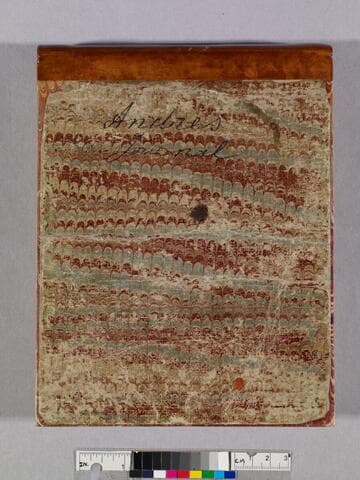
Journal of John André, 1777, June 11 - 1778, Nov. 15
Manuscripts
Journal that André kept while aide-de-camp to Charles Grey, from June 11, 1777 to November 15, 1778. There are no entries for the period from Dec. 30, 1777 to June 1778. The journal covers the Philadelphia campaign and its aftemarth, including the battles of Brandywine, Germantown, White Marsh, and Monmouth; British raids in New Bedford (1778, Sept. 5-6) and Martha's Vineyard (1778, Sept. 10-15) and Baylor's massacre at Old Tappan, N.J. (1778, Sept. 27) Also included are returns of troops under the command of Sir William Howe and Henry Clinton.
mssHM 626
Image not available
Walter Scribner Schuyler letters
Manuscripts
These six letters document aspects of Lieutenant Schuyler's service on the Northern Great Plains in 1870-1871 (Wyoming and Nebraska), followed by his involvement in the 1877 campaign that brought the Great Sioux War of 1876-1877 to a conclusion. Schuyler mentions: George Crook, Thomas Duncan, John Gregory Bourke, Crazy Horse, Sitting Bull, and Spotted Tail. The letters were written to Schuyler's father, mother and Albert C. Snyder. There is also a receipt and five newspaper clippings.
mssHM 83593-83599
Image not available
Walter Scribner Schuyler papers
Manuscripts
A collection of 152 items from 1811 to 1932, it consists of letters written by Walter Scribner Schuyler to his parents about his army service in the West, especially in Arizona Territory between 1872 and 1874; letters from George Crook about Indian affairs in the 1870s; an account of a survey party Schuyler conducted to Yellowstone National Park in 1883; and his 1904 report as a military observer during the Russo-Japanese War. Of note are 46 journals written by Schuyler between 1898 and 1932, detailing his later military career and his business affairs. There is also correspondence from Philip Henry Sheridan to George Crook in the collection, as well as a typescript of a sketch by Azor Howitt Nickerson titled: Major General George Crook and the Indians [after 1890].
mssWS
Image not available
Juan Ruiz Apodaca letterbooks
Manuscripts
This collection consists of some 145 reports written by Juan José Ruiz de Apodaca, count of Venadito, one of the last viceroys of New Spain. Ruiz de Apodaca prepared them for the Spanish Minster of War. The reports (called cartas, ie, letters in English) are detailed summaries of the Ruiz de Apodaca's work as viceroy and cover his entire time as viceroy (1816-1821). Each report is numbered and begins with a précis of the report; there are also cross references to other reports. The dominant theme of the reports is the Mexican War of Independence. Ruiz discusses troop movements, loyalties of regional authorities, actions throughout Mexico to quell the rebellion. Such accounts are sometime month-to-month and discuss specifically the names of persons involved, eg, Francisco Xavier Mina, the rebel leader; or Joaquín de Arredondo, the Spanish military commander. In addition, Ruiz de Apodaca discusses the impact of the revolutionary war on Mexican society. He also provides such details as list of supplies requisitioned for the government.
mssHM 226