Visual Materials
Photographs of the Nagasaki and Hiroshima bombing aftermath
You might also be interested in
Image not available
Photographs of the Nagasaki and Hiroshima bombing aftermath
Visual Materials
photCL 751
Image not available
Nagasaki miyage
Rare Books
This book deals with the manners and practices of both the Chinese and western people living in Nagasaki. The first half of the books has illustrations, the second half is commentary.
720148
Image not available
Yoshiko Doida photograph album
Visual Materials
A photograph album documenting Japanese American Yoshiko Doida's experiences studying abroad in Hiroshima, Japan, 1933 to 1938. A Los Angeles nisei, Doida was likely part of a group of Japanese American students who were selected for scholarship programs to study in Japan in the 1930s. The album's inside cover is gilt stamped "Yoshiko Doida, L.A., Betsuin Y.W.B.A." (Young Women's Buddhist Association). The first photographs begin with her 1933 steamship journey from Los Angeles to Hawaii, and then to Japan, where she is seen posing with Japanese family members. The remainder of the album contains family photographs, studio portraits of Yoshiko in traditional Japanese clothing and hairstyle ("first time in Shimada" she writes), visits to shrines and tourist sites, and many images of Yoshiko at school in Hiroshima. Handwritten captions appear throughout, mostly in English, with some in Japanese. She is seen pictured with her class at Hiroshima Women's College in 1934, and with school friends in town and on outings to the beach, Mount Aso, the "Famous Iwakuni Bridge," and elsewhere. There are a few formal portraits of Yoshiko with her parents, and her parents are also in scenes in Japan. It is likely that some of the sites in Hiroshima that are pictured were later destroyed by the atomic bomb during World War II.
photCL 646
Image not available
The Map
Rare Books
"A dozen years after the atomic bomb was dropped on Hiroshima, out of nowhere a giant black 'stain' appeared above the basement ceiling of the Atomic Bomb Dome. Each night the 'stain'--which I had seen myself--filled my dreams with a sense of horror ... one early summer evening, I sneaked into the seemingly isolated Atomic Bomb Dome all by myself. I could not take my eyes off the crack above the dark, damp basement ceiling ... One part of the ceiling contained a whirlpool of calligraphy which fully absorbed black magic. It was there that I first saw the raw image of the atomic bomb for myself ... The images in my book 'The Map' might not be suggestive or promising, but within the monochrome pictures doesn't the 'stain' provoke the imagination and amplify voices which no longer exist?"--From introduction.
653097
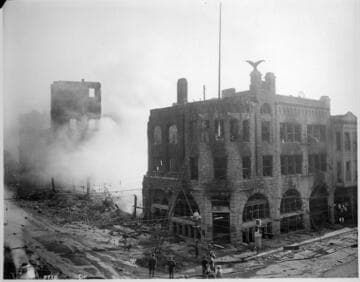
Aftermath of the bombing of the Los Angeles Times Building
Visual Materials
A view of the bombed Los Angeles times building with smoke still rising from the site. There is a policeman and a few spectators in the foreground.
photCL Pierce 00086
Image not available
Photograph album of a Japanese American soldier in the U.S. occupation forces in Japan
Visual Materials
A personal photo album compiled and annotated by a Japanese American serviceman who served in the U.S. occupation forces during the post-World War II occupation of Japan. The album begins with his departure from Hawaii to Japan in 1946, including one image of his old school, McKinley High School in Honolulu. In Tokyo, there are many photographs of fellow soldiers, as well as Japanese young men and women; buildings and landmarks; parks; and army buildings. Two images of a large building are described as General Douglas MacArthur's headquarters in Tokyo, and there is one image of him walking out of the building. Besides Tokyo, the soldier is seen in Kamakura and Otake, near Iwakuni, where he may have been stationed later. Of note are a few images of building destruction in Hiroshima, 1947, in the aftermath of the atomic bombing. At the back of the album are many single and group portraits of Japanese residents, possibly family members or acquaintances in Iwakuni and Otake. The album has handwritten captions in English, with occasional captions written in Japanese.
photCL 667